I want to start this off by saying I understand the trinity is deeply ground into the faith of many. A few months ago, even saying this thought out loud felt.. well, blasphemous.
As I’ve spoken about before, I was raised mixed-yoke, Catholic with some Judaism sprinkled in. The only church understanding I received was strictly trinitarian. I never questioned it to anyone, but there was always something in me that didn’t really get it. I even tried to explain it to others and found I could not in a way that felt solid.
Then a few months ago I joined a Torah-observant women’s group; and I found that when one women asked about it, many others revealed they too had doubts. So, as I do, I decided to deeply research it.
In the Beginning
I’m going to start this view with John 1:1- we all know it. As always, unless otherwise stated, I go off of the Greek transliteration.
In [the] beginning was the Word, and the Word was with God and God was the Word.
It doesn’t say the Son was with God- it says the Word.
The Greek: En archē ēn ho logos, kai ho logos ēn pros ton theon, kai theos ēn ho logos.
A literal breakdown
- En archē– In [the] beginning; of a Kingly or Magisterial Rule
- ēn– was / existed
- kai ho logos– And the Word; an embodiment of speech; a statement
- pros ton theon– with God; toward God; denoting local proximity
- kai theos ēn ho logos– And God was the Word / Divine was the Word*
*In the final phrase, there is no definite article preceding Theos as before (“ho“), which led to some translations saying “And the Word was Divine.” This grammar is actually one of the reasons John 1:1 became such a major theological debate point in early assemblies centuries (before the creeds.)
Another interesting thing here is that “pros” does not simply mean “beside” or “next to.”; its core meaning is “toward,” “facing,” “in relation to,” or “in the presence of.”
In Hebrew thought, a “word” is something that happens, not just something that is said-
Dabar (דבר) is a nuanced term that means spoken communication, a thing/ matter of subject or something that accomplishes an action.
“Word” is often read in a philosophical way. But from a Hebrew perspective its
- YHVH expressing Himself in action
- His will, command, power, and manifestation
Then it’s more accurate to say that from the beginning of God’s rule over the universe, He had a purpose– an expression of His will that would one day be revealed in Yeshua, guiding creation and humanity according to His covenant and instructions.
And the Word flesh became and dwelt among us, and we beheld the glory of Him, a glory as of only a begotten Son from [the] Father, full of grace and truth.
– John 1:14
The Greek: Kai ho logos sarx egeneto kai eskēnōsen en hēmin, kai etheasametha tēn doxan autou, doxan hōs monogenous para patros, plērēs charitos kai alētheias.
- kai– and
- ho logos– the Word; an embodiment of speech; a statement
- sarx– flesh; human flesh, body; materiality; kindred
- egeneto– became; came to be, came into existence or being
- kai eskēnōsen– and dwelt; as in a camp; to have tabernacled
- en hēmin– among/ with us
- kai etheasametha– and we saw, beheld; as to contemplate or look upon
- tēn doxan autou– The glory of Him; the honor; the splendor
- doxan hōs– glory like as; according as, as it was
- monogenous– only; unique; from monos (one) and genos (kind, type, class or lineage)
- para patros– from; beside, in the presence of Father
- plērēs charitos– full, abounding it, complete in favor or gratitude
- kai alētheias– and truth; not as merely spoken; truth of an idea or reality; sincerity; in the moral sphere; straightforwardness; divine truth.
The word monogenous (often translated as “only begotten Son”) is also used in The same word appears in Hebrews when referring to Isaac (Yitshaq):
By faith has offered up Abraham Isaac. Being tested even [his] monogenē was offered up the [one], the promises having received.
– Hebrews 11:17
But Isaac was not literally Abraham’s only son, since Yishmael still existed.
Isaac was called monogenē because he was the unique covenant son; there was no other like him.
Words like logos and monogenēs in the Gospel of John became central to the debates that eventually led to the doctrine defined at the First Council of Nicaea under Constantine, where Arius argued that these passages described the Messiah as uniquely appointed by God rather than eternally equal to Him.
Other verses I’ll be going over at length in a separate post on our Beyond Creed page (When I post that I’ll link it here):
John 8:58– Said to them Yeshua, “Amen, amen I say to you: Before Abraham was, I am.”
John 10:30– “I and the Father one are.”
John 20:28– Answered Thomas and said to Him, “The Lord of me and the God of me.”
Colossians 2:9- For in Him dwells all the fullness of the Deity bodily
Philippians 2:6– Who in form of God existing, not something to be grasped, considered to be equal with God
For now- let’s talk about the history that led to the trinity doctrine
From Nero to Constantine
I want to start with a list of New Testament books relevant to the events. Knowing the chronological order helps us see what the apostles were dealing with when they wrote their letters. Several of these writings were produced during the time of persecution under the Roman Emperor Nero (54-68 AD)
When the books are read in the order they were written, passages about suffering and endurance take on a clearer meaning because the early followers of Yeshua were facing real pressure and danger during that period.
- 1st & 2nd Corinthians (~53-56 AD)
- Romans (~56-57 AD)
- Paul’s imprisonment: Philippians, Colossians, Philemon & Ephesians (~60-62 AD)
- (debated; possibly) Hebrews (~60-70); assumably before the 2nd Temple falls, because this event would have been mentioned
- The Gospel of Mark (~65-70 AD)
- 1st and 2nd Peter (~60-64/65-68 AD)
- and possibly Jude (~65-80 AD)
During this time, historically followers of Yeshua were:
- A small, non-dominant movement, distrusted by the Roman authorities
- Viewed as “atheists” because they rejected Roman gods
- Seen as socially disruptive for refusing emperor worship, temple sacrifices and guild feasts
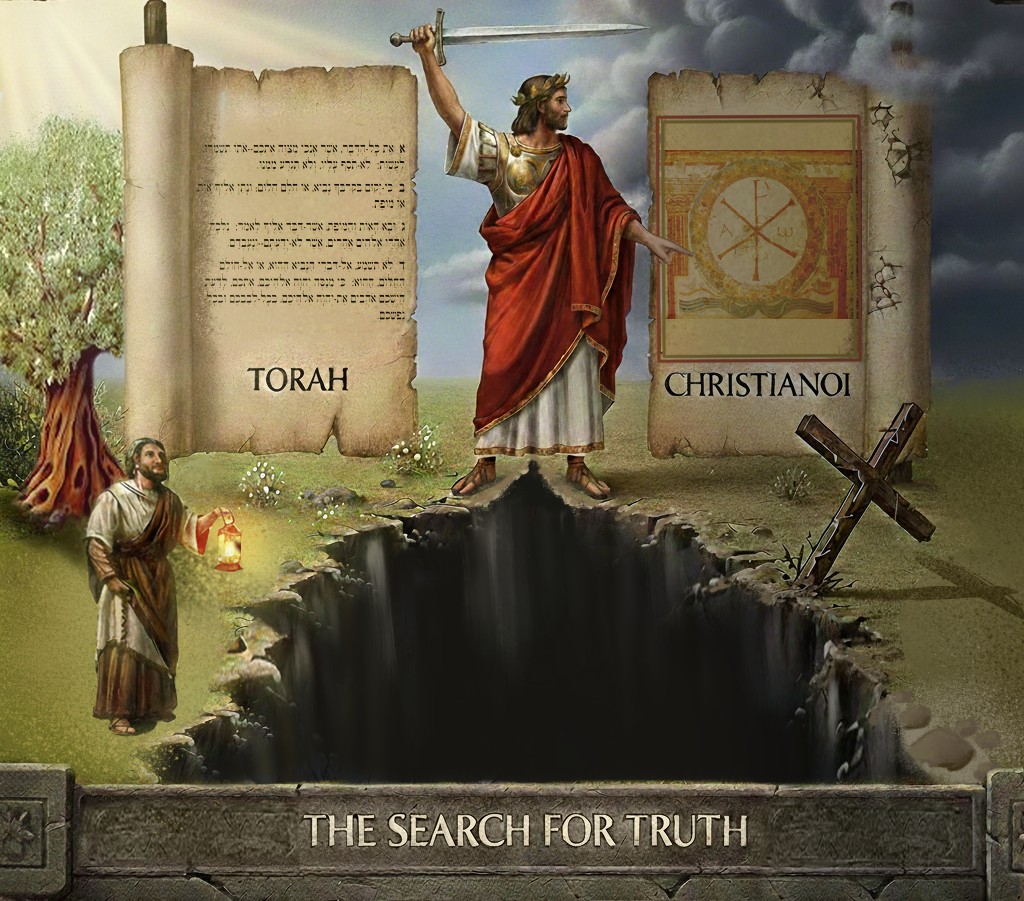
- Labeled “Christianous”* as a mocking term by the Romans, a label that believers later adopted and which became widely used in the Roman world after the reign of Constantine
* Followers of The Way (Acts 9:2) were first called Christianous in Acts 11:26, but this was a name given by others, not what they branded themselves.
The Great Fire of Rome (64 AD)
After the fire, Nero needed a scapegoat, and he decided to focus his wrath upon the minority. Persecution:
- flared mainly locally in Rome and around it
- was complaint driven, related to refusal to honor the Roman empire or their gods
- mainly effected followers who were viewed as socially disruptive because of their refusal to engage in the expected social order
But there was no real “widespread persecution”.
Most early believers lived quietly and were not trying to convert the Empire.
Later church history amplified stories of persecution, highlighting suffering and martyrdom to strengthen the authority and legitimacy of emerging church leaders.
Between the 100s and 300s, Faith was far from uniform. There were Torah-observant followers of the Way, communities that held strictly to Jewish practices, and Greek-influenced groups that interpreted faith through Hellenistic philosophy. Proto-Gnostic groups also emerged, emphasizing secret knowledge, or “gnosis,” as the key to salvation. Many communities continued to faithfully observe the Sabbath and biblical feasts.
There was no formal “Church” yet at this point. Apostolic followers met in homes, shared meals and broke bread together (Acts 7:48; 17:24). This was the kind of community Yeshua had envisioned- close-knit, centered on fellowship and open to discussion and debate.
To Rome, however, these small, independent groups were seen as a potential threat to imperial authority and social order.
Constantine: The Great Conqueror
Emperor Constantine is often praised for legalizing Christianity, but that’s more of a false narrative-
Constantine “came to Christianity” for political reasons, while continuing pagan practices, seeking holy relics for increased power, and blending religions to consolidate his empire.
What did Yeshua say about rulers?
And Yeshua having called to them said, “You know that the rulers of the Gentiles exercise lordship over them, and the great ones exercise authority over them. Not thus will it be among you, but whoever if wishes among you to become great will be your servant. And whoever wishes among you to be first will be your slave.”
– Matt 20:25-27
The famous Chi-Rho ☧ “vision” Constantine claimed was not divine instruction, but a strategic story used to motivate troops, unify his army, and gain political legitimacy. In some sources, Constantine claims that he and his entire company of soldiers saw a vision in the sky. In other accounts, however, his soldiers report it as a dream or a private revelation. (And of course, using crosses as signs or for veneration borders on graven images.)
YHVHs ways are life-giving, not conquest-driven.
His vision is for covenant obedience, justice, mercy and the building of His Kingdom through faithfulness- not through war, political domination, or the spilling of blood. Any vision promising victory by killing others in the name of Yeshua contradicts His character and violates basic covenant principles.
Because of this shrewd and conquest driven ruler, the faith of the early followers of the Way underwent a decisive shift.
Covenant became an Imperialized religion.
Constantine Recasts Believers
The creeds that emerged under Constantine were designed to unify a religiously diverse empire, not to preserve the lived practice of the early believers. Commandments tied to Yisrael’s God- the Sabbath, appointed times, dietary distinctions, and covenantal markers- were increasingly portrayed as obsolete, burdensome, or even dangerous. Torah obedience became a liability.
This was not accidental. A faith that required submission to YHVH’s instructions would have been far harder for a pagan empire to accept, and even more difficult to control.
By defining orthodoxy primarily through belief statements rather than obedient living, Constantine’s creed made faith easier to swallow:
- Loyalty was redirected from covenant faithfulness to doctrine.
- Unity was achieved by shared confession, not shared obedience
- Faith wasn’t about how one walked, but whether one aligned with the approved creed.
Torah was reframed as “Jewish,” obedience as “legalism,” and covenant loyalty as something belonging to a previous age-
Not to “Christians”. Nuanced scriptural categories were flattened into simplified formulas that could be quickly taught and easily enforced across the empire.
Where the trinitarian doctrine started
The First Council of Nicaea was convened by Emperor Constantine- not disciples, prophets or faithful elders. Some 250–318 bishops were in attendance, almost entirely made up of Gentile leadership. Most were trained in Greek philosophy and Roman rhetoric- but not in Scripture.
They gathered mainly to debate the Arian Controversy:
Arius of Alexandria (256-336 AD)
A Gentile scholar and presbyter from Libya, trained under Lucian of Antioch, who was known for emphasizing literal, grammatical readings of Scripture and pushing back against allegorical and philosophical excesses.
Arius was trying to protect the oneness and supremacy of God the Father. His key convictions:
- YHVH alone is eternal, unbegotten and without origin
- The Son (Yeshua) was begotten by the Father meaning:
- He had a beginning
- He was subordinate to the Father
- He was the highest of all created beings, through whom everything else was made
Arius famously summarized this view as, “There was a time when the Son was not.”
While Arius affirmed Yeshua as Messiah and affirmed His role in creation, redemption, and exaltation, he rejected the idea that the Son was co-eternal.
This is what the Council had convened to debate: Was the Son created, or Co-eternal?
Because they were not scholars of Torah, this was framed in Greek metaphysical categories, and creedal Language not found in Scripture was introduced. The council also introduced the term homoousios meaning “of the same substance”.
This idea comes from directly from Greek philosophy, which believed in Platonism:
- Reality is built from unchanging essence “ousia”
- Higher beings have eternal forms which are unchanging and perfect
- Any change or hierarchy meant there were inferior forms
So, they decided if the Son were divine, He had to have been of the same exact essence of God.
But, the glaring problem with this is that Scripture speaks relationally: Father, Son, sending, obedience, inheritance- not metaphysically.
The Council set the precedent that extra-biblical philosophical language could define “orthodoxy”. They effectively made questioning Messiah’s divinity heresy, and because he refused to submit, Arius was excommunicated and his work was burned.
That seems like a strong reaction to a mere debate, does it not?
This is often breezed over, but it’s important to note this one decision set a precedent that changed and shaped Christianity forever:
- Theology was now enforced by state power
- Emperors could define doctrine
- Philosophical terms could override Scripture
- Faith could be enforced, but not debated
- Obedience was secondary or irrelevant
This was a sharp departure from any apostolic practice, and opened the gate to other non-scripture pagan originated ideas:
The Council of Laodicea (363- 364 AD)
- explicitly discouraged Sabbath keeping, calling Sunday “the Lord’s day”
- In Roman- “Dies Solis” literally means “Day of the Sun”
- Romans celebrated the sun god (sol Invictus) on this day before it was adopted to Christianity
Influential Men (later called saints)
John Chrysostom (347- 407): an Arch bishop of Constantine who reinforced anti-Judaizing rhetoric, framing Torah observance as old, legalistic, or dangerous.
Augustine of Hippo (354–430): He Correctly emphasized salvation by grace and faith, but downplayed the continuing relevance of the Law
Jerome of Stridon (347–420): A translator of the Latin Vulgate who reinforced the separation of Old Testament Law from Christian practice and emphasized asceticism
Asceticism– the voluntary, systematic practice of self-discipline, self-denial, and renunciation of sensual pleasures or worldly comforts to attain higher spiritual, religious, or personal goals; it involves fasting, poverty, celibacy, and seclusion (Paul specifically warned against that- Colossians 2:20–23)
The “Early Church fathers”
Constantine elevated philosophers, bureaucrats, and elites as the so called “early Church Fathers.” Their priorities were not order and political control.
1. Philosophers over shepherds
- Leaders were trained in rhetoric, law, and debate, not Torah obedience or practical discipleship.
- Sermons became Greek- style monologues of philosophical reasoning rather than pastoral teaching.
2. Taxation and imperial control
- Constantine extended the state’s rule into the church, imposing taxes on land and clergy.
- In turn this pressured the congregation to support the church, rather than the church supporting the congregation
- The church became a financial and political instrument, rather than a covenant based community.
3. Architecture and hierarchy
- Churches were designed after Roman basilica’s and government buildings, emphasizing authority, hierarchy, and grandeur over intimacy or community
- Worship became formalized ritual and spectacle, not relational covenant walking.
- The first known physical church was St. Peter’s Basilica in Rome- built by- who else- Constantine. (319-330 AD)
4. Doctrine over obedience
- With elites and philosophers shaping doctrine, the focus shifted from following YHVH’s commands to agreeing with Creeds.
- Torah obedience became irrelevant
- Confession and alignment with institutional authority became the acceptable measure of “faith.”
Constantine didn’t just legalize Christianity- he politicized it, bureaucratized it, and intellectualized it, ensuring the faith would serve the empire, rather than shape it. The church became a state-managed institution, smooth and digestible, but far removed Scripture, which explicitly warns us of faith becoming institutionalized and focused on power (Ezekiel 34:1-4, Jeremiah 6:13-15, Jeremiah 23:1–2, Micah 3:11, Matthew 15:7–9/Isaiah 29:13 )
Because of this Idea that the Empire could dictate doctrine, Salvation became less about obedience through faith and more about Unity and Church regulated ritual and un-biblical doctrine:
- Baptism: removes original sin and initiates salvation, rather than being a show of faith (implemented late 300’s)
- Eucharist & Communion: The idea that bread and wine literally become the body and blood of Messiah (later called transubstantiation), and repeated participation dispenses repeated grace (early practice but defined officially in 1215)
- Confession: Rather than verbally aligning with YHVH, sin must be confessed to a priest; prescribed acts (penance) restored salvation (6th- 9th century, official doctrine in 1215)
- Confirmation: an anointing done by a priest which is meant to strengthens the grace received by baptism and seal them with the Holy Spirit
- Indulgences: Reduce divine punishment for sin through acts, payments, or devotion; (11-13th century, heavily abused by 1500)
The Protestant Reformation (1517-1648)
Martin Luthor’s Protestant Reformation challenged Rome’s abuses and (correctly) rejected salvation by works, indulgences, and institutional control. Yet in pushing back against merit-based righteousness, the Reformers inherited the same framework of a more easily digestible faith.
Torah obedience remained excluded, and obedience itself became suspect. What Scripture describes as the fruit of faith was treated as a threat to grace, rather than as evidence of that grace.
The Faithful Remnant
The results of these systems are lasting in modern faith:
- Creed replaces covenant
- Belief is separated from obedience
- Torah is dismissed as irrelevant or undermining Grace
- Judgment is reduced to destination rather than measured by accountability
- Faith becomes institutionalized, funded, and managed- requiring clergy salaries, buildings, and systems that had to reshape theology to sustain themselves
- The Trinitarian view is elevated as a central article of faith, making it easier to claim that the Son acted against the Father, or that He or His disciples taught others to set aside Torah
Yet even as these developments took hold, some believers continue walk in covenant faithfulness. In Scripture and across generations, there were always those who refused to separate belief from obedience, who seek to honor the Father in their daily lives and keep His instructions at the center of their faith.
The debates over the trinity and the nature of Yeshua never erases the example of the faithful, who live in humility, love and service, passing on the ways of the covenant. True faith has always been more than creeds or theology; it is about walking in alignment with YHVH’s ways, following Yeshua’s example and trusting that God’s covenant remains alive for all who seek Him sincerely.
Every teaching and tradition must be measured against Scripture. True faith is not about unquestioned doctrine or human authority- it is about returning continually to YHVH’s Word, walking in His ways and following Yeshua in obedience and discernment. By testing everything, even trinitarian claims, against Scripture and the teachings of the Messiah, we stay rooted in the covenant that has guided God’s people from the beginning.
Leave a Reply