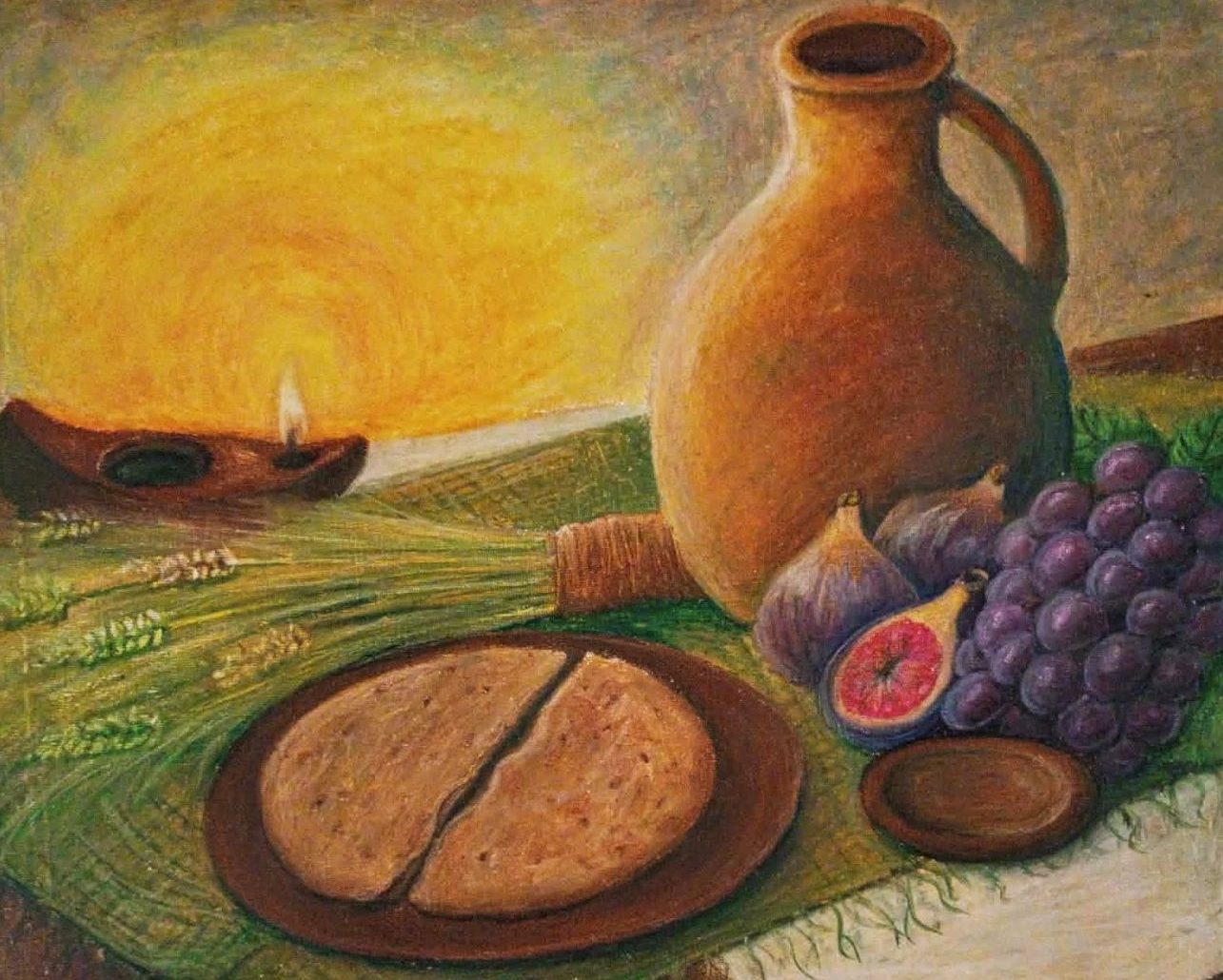
Since becoming Torah Observant last year, I have been looking forward to the first appointed time of YHVH- Passover, or Pasech.
I know most Christians celebrate easter and we did too when I was growing up. Full on pagan easter too, not even trying to remember Yeshua- eggs and ham and candy/ toy baskets. Then when I actually was pagan I celebrated Ostara, a Germanic deity and the spring equinox. I definitely went all out and learned everything. So I’ve been excited to put that same level of devotion towards God- Praise be to Him!
Why Observe Pasech?
The story of Pasech is pretty well known to believers- YHVH sent the 9 plagues to free His people, but Pharoah’s heart was hardened. So YHVH brings death to the firstborn sons of any house who did not mark their doorposts with the blood of a lamb sacrificed to Him:
And I will pass through the land of Mitsrayim (Egypt) on this night, and will strike all the firstborn in the land of Mitsrayim from man and to beast, and against all gods of Mitsrayim, I will execute judgement. I [AM] YHVH.
And shall be the blood for you a sign on the houses where you [are] and when I see the blood, I will pasach over you and not shall be the plague to destruction when I strike the land of Mitsrayim.
– Exodus 12:12-13
“Pasach” means to spare or to protect.
Many Christians believe that because Yeshua is the Paschal Lamb (1 Corinthians 5:7), we no longer have to keep YHVH’s appointed feasts. That view tends to rest on the idea that “fulfill” means cancel. Yet Scripture tells us these were not meant to be temporary observances:
So shall be this day to you a zikkaron (remembrance) and you shall observe the feast as a feast to YHVH, throughout your generations [an] ordinance olam you shall hold the feast.
– Exodus 12:14
Olam is often translated as “forever”- but it carries a richer meaning: not just unending, but hidden, timeless, and extending through all generations. When Scripture says Pesach is to be kept olam, it emphasizes that this feast is a perpetual appointed time, a living symbol pointing to YHVH’s redemption story across the ages.
The New Moon and the Start of the Year
And spoke YHVH to Mosheh and Aharon in the land of Mitsrayim saying, “This chodesh [shall be] your Rosh Chodesh. The first it [shall be] to you chodesh of the year.”
– Exodus 12:1-2
“Chodesh” is normally translated as ‘month’ but obviously the Yisrealites didn’t have months- they had moon cycles. Chodesh means “newness” or “renewal”; the time of renewed moon visibility, the new crescent moon. Rosh means “head” or first, as in chief.
So Rosh Chodesh means “head of renewal” and marks the beginning of a new lunar cycle.
In Leviticus we’re given more details about Pasech:
In the first chodesh, on the fourteenth of the chodesh, bayin ha’arbayim (between the evenings), [is] Pesach to YHVH.
On the fifteenth day of the same chodesh this [is the] Feast of Matzot to YHVH.
Seven days matzot you shall eat. On the first day a convocation holy shall have you. Any work customary not shall you do.
– Lev 23:5-7
So the pattern goes:
- a certain New moon= the start of Aviv
- 14 days later is Pasech
- The day after Pasech starts the Feast of Unleavened Bread (Matzot); the first day of the seven days is a High Shabbat
Which New Moon?
During the spring, when the barley in Yisrael begins to ripen, Jewish authorities in Jerusalem carefully observe the New Moon to declare the start of the first month of the biblical year, known as Aviv (or Nissan in Babylonian tradition).
This observation sets the timing for all YHVH’s appointed feasts, ensuring that Pesach and the following festivals are celebrated in alignment with both the lunar cycle and the season ordained by our Father.
This year the New Moon came around 5 AM on March 19th- that means the official starting “day” of the year was sundown that day. From there, we count out 14 days- sunset to sunset- where Pasech falls on the evening of April 1st, a Wednesday. Interestingly enough, this follows the same timeline as Yeshua’s last week.
Pesach and the Last Supper
It’s a commonly held belief that Yeshua was crucified on a Friday, often called “Good Friday.” However, when we examine the timing of Pesach according to the biblical calendar, this timeline doesn’t align with Scripture.
Three Days
For just as Yonah was three days and three nights in the belly of the sea-monster, so will the Son of Man be three days and three nights in the depths of the earth.
– Mattityahu 12:40
We know “days” in Biblical understanding go from sundown to sundown. The word day “Yom” in Hebrew doesn’t always mean daylight either; sometimes it means sundown to sundown, other times it means an entire 24 hour period, and others it means a part of a typical ‘day’.
Yeshua’s “Last Supper” was not the official Pasech meal:
Scripture says:
[6] “‘You are to keep it until the fourteenth day of the month, and then the entire assembly of the community of Yisrael will slaughter it bayin ha’arbayim (between the evenings)
[8] That night, they are to eat the meat, roasted in the fire; they are to eat it with matzot and maror (bitter herbs)
-Exodus 12:6, 8
Because the official command is bayin ha’arbayim “Between the evenings”, it allowed for some concessions to be made later in the 2nd Temple era.
During the week of Pasech, tens of thousands of Yisraelites would journey to Jerusalem, each household bringing a lamb. And because of the Temple logistics of inspecting and slaughtering thousands of lambs, it became customary for people to bring their lambs in the afternoon of the 13th, roasting and eating them that evening (the start of the 14th). This was more of community unification though, and not the official Pasech.
- After the communal meal, Yeshua is betrayed and arrested
- John 19:14 puts Him before Pilate at “the sixth hour”
- The Synoptic Gospels put Yeshua’s crucifixion between the third & ninth hour (Mark 15:25-33; Matt 27:45; Luke 23:44)
John uses Roman Civil time– 6 hours counted from Midnight; putting Yeshua’s trial at 6 AM.
Mark, Matthew and Luke use Jewish Sundial time– 3-6-9 hours after sunrise; that’s 9AM, 12 PM and 3 PM.
The Gospel of John gives us a very important clue as to what day this is:
Then the Judeans, because Preparation it was, so that not would remain on the stakes the bodies on the Shabbat- was indeed a high day that Shabbat– asked Pilate that might be broken their legs and they might be taken away.
– John 19:33
John says this Shabbat they were preparing for was High Shabbat- but Pasech isn’t a High Shabbat, it’s a remembrance. The day following Pasech is a High Shabbat, the first day of the Feast of Unleavened Bread.
13th of Aviv (Tuesday sundown- Wednesday sundown) Day of preparation; removing all leavened bread.
14th of Aviv (Wednesday sundown to Thursday sundown)
- Community dinner, arrest, trial & crucifixion
- Official Temple slaughter of the Paschal Lamb
- Taking down and rushed burial preparations; placed in the tomb before High Shabbat
15th of Aviv sundown begins the High Shabbat (Thursday sundown through Friday sundown)
16th of Aviv begins the weekly Sabbath (Friday sundown to Saturday sundown)
Yeshua rises between Saturday sundown and dawn Sunday morning; 17th of Aviv; First fruits (bikkurim), which falls the day after the Shabbat during the Feast of Unleavened Bread ( though debated that it falls after the High Shabbat in Pharisaic/ Rabbinical traditions).
This timeline fits Pasech, historical tradition, why the women/ Mary were so intent on visiting His grave before sunset- they had gone 2 days without finishing the burial. They bought and prepared spices (Mark 16:1/ Luke 23:56) after sundown on Saturday (since they could not have done it on the High Shabbat or weekly Shabbat), and at dawn/daybreak (Mark 16:2/ Luke 24:1) they go to finish the burial.
The Feast of Unleavened Bread
Immediately following Pasech, the Feast of Unleavened Bread begins, a seven-day period where leaven (yeast*) is removed from homes and only unleavened bread is eaten:
Seven days Matzot you shall eat. On the first day you shall remove seor (leaven) from your houses; for whoever eats chamets (leavened bread) shall be cut off that person from Yisrael from the first day until the seventh day.
– Exodus 12:15
This feast reminds us that deliverance from Egypt wasn’t just about freedom from slavery, but also a call to obedience and holiness. Just as Yisrael was commanded to remove leaven from their homes, we are called to remove sin and anything that corrupts our hearts.
Each piece of unleavened bread at our tables symbolizes sincerity and purity, reflecting a life fully committed to walking in God’s ways after experiencing His salvation. It reminds us that freedom is not just a gift- it comes with the responsibility to live faithfully.
Pasech is the deliverance; the Feast of Unleavened Bread is the obedience and transformation that comes afterwards.
*I want to point out that the biblical command is specifically about seor– meaning a fermenting agent- sour dough or yeast. It doesn’t mean baking soda, baking powder, eggs, honey or other ingredients people sometimes worry about. I know this topic can get debated, but let’s remember that YHVH’s commands are perfect and not burdensome. This isn’t a call to remove anything that might leaven; it’s a call to remove yeast itself.
Firstfruits (Bikkurim)
And shall wave the omer before YHVH to be accepted on your behalf; on the morrow the Shabbat shall wave it the priest.
– Leviticus 23:11
During Firstfruits, the priest waved a sheaf of barley before the YHVH to acknowledge His provision and set the offering apart:
By offering the first of the harvest, Yisrael recognized that everything comes from God, and that they were dependent on His blessing for the rest of the crop. Waving the sheaf in multiple directions symbolized that the offering was set apart for God.
Link to the Counting of the Omer– From the day the Omer is waved, we count seven Shabbats (49 days) leading to Shavuot (Pentecost). The wave offering marks the start of a spiritual journey, reminding followers to live in obedience and expectation of God’s fulfillment.
Just as the first omer of barley is offered and accepted by God, Messiah is the Firstfruit whose resurrection brings acceptance to all who are “harvested” into God’s covenant people.
The seventh day of The Feast of Unleavened Bread is also a High Shabbat (Leviticus 23:7-8), a holy convocation when no ordinary work is done. It marks the completion of the purification period, reminding believers that deliverance and obedience are ongoing, not just a one-time event.
Celebrating Deliverance and Life
As we observe Pasech, the Feast of Unleavened Bread, and Firstfruits, we’re reminded that YHVH’s deliverance is not just a story from the past- it’s alive and active in our lives. Each part of the feast teaches us something important: Pasech shows us the cost of redemption and God’s protection, the High Sabbaths invite us into rest and worship unhindered.
The removal of leaven reminds us to let go of anything that corrupts our hearts, while Firstfruits encourages gratitude and dedication for all The Father provides. The final High Sabbath on the 7th day calls us to pause and reflect on the journey we’ve been through, both in God’s faithfulness and in our own walk of obedience. Celebrating these days connects us to the rhythm He established and invites us personally into His story- His protection, His provision, and His promise of life renewed in Yeshua.
Shalom friends, and a very fruitful Feast Week to you all!
Leave a Reply