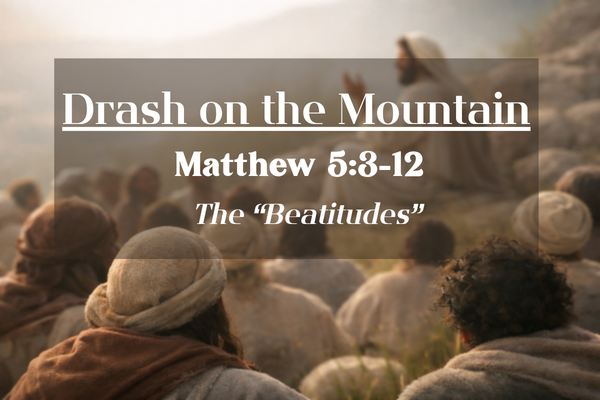
The opening words of Yeshua’s teaching in the Gospel of Matthew 5 begin with a series of statements referred to as the ‘Beatitudes’. These are not random blessings, nor are they new ideas. They are deeply rooted in the language and themes of the Torah and the Prophets.
What is Blessing?
The word “blessed” (Makarios) reflects the Hebrew idea of ashrei, a term used throughout Scripture to describe the one who is walking in alignment with YHVH. This language is seen in Psalms 1:1–
“Blessed the man who not does walk in [the] counsel of the wicked and in the derek (way, path) of the sinful, nor stands also in the seat of mockers, nor sits.
That if in the Torah of YHVH his delight [is], and in His Torah he meditates day and night, so he shall be like as a tree planted by the rivers of water, that its fruit brings forth in its season. And whose leaf not shall wither and whatever he does shall prosper.”
This reflects the language of Deuteronomy 30:19–
“I have made witness among you today Heaven and earth: Life and death I have set before you, blessing and cursing. So choose life, that you may live, you and your descendants.”
YHVH sets before His people life and death, blessing and cursing. Blessing is not arbitrary- it is the result of walking in His ways. Yeshua’s words reflect this same covenant reality: He is identifying those who are choosing life.
3 “Blessed are the poor in spirit, for theirs in the Kingdom of the Heavens.”
Yeshua often refers to the Prophets in His teachings; in the first sentence of His speech, He paraphrases Isaiah:
For all these My hand has made and became all these. Thus utters YHVH, But this will I look, on [the] poor and contrite of spirit, and who trembles at My Word.
– Isaiah 66:2
Isaiah 66 is addressing the people of Yisrael who had returned from exile, warning them against empty ritual and outward appearances of devotion. Many were performing sacrifices and observing Torah, but their hearts were distant, proud or self-serving. YHVH contrasts this with those who are truly His- the humble, repentant and contrite of spirit.
Yeshua’s parallel draws directly from this message: Those who are “poor in spirit” recognize their dependence on God and approach His Word with humility. The Kingdom of Heaven belongs to them because they align with God’s covenant intentions, not just performing duties, but living in obedience and reverence that is from the heart.
This connection makes it clear that blessing is defined by internal alignment with God, not by status, wealth, or outward religiosity- a truth Isaiah emphasized for Israel and Yeshua reaffirms for His followers.
4 “Blessed are those mourning, for they will be comforted”
This is more than just personal grief- it’s about mourning over sin, injustice, and the brokenness of the world.
In the book of the Prophet Ezekiel, during Babylonian exile, Jerusalem had been rebellious, idolatrous and sinful despite repeated warnings from YHVH through His prophets. Ezekiel is given a vision of judgment on Jerusalem, describing how YHVH will punish the city for its abominations, but He protects those in alignment with Him:
And said YHVH to go in the midst of the city, in the midst of Jerusalem and set a tav (mark) on the brows of the men who are groaning and the men who are crying over all the abominations which are done in their midst.
– Ezekiel 9:4
The contrast is stark: those who mourn over sin (the truly righteous and repentant) are preserved, while the rest face destruction.
This reinforces a key principle: God honors a heart that is sorrowful for what He hates, and He brings comfort and protection to such people.
Yeshua echoes this principle: mourning over sin and brokenness is the posture God desires. Just as Ezekiel’s mourners were marked and preserved, Yeshua promises comfort and blessing to those who grieve rightly.
5 “Blessed are the meek, for they will inherit the earth.”
“Meek” or Praeis in Greek means gentle, humble, mild and not self-asserting-
In the New Testament, it often describes someone who does not dominate others, but instead exercises strength under control. This is not weakness, but controlled power which is guided by humility.
In the Hebrew anav gives us the same idea: Humble, lowly, gentle & modest. It describes someone who recognizes their dependence on God and submits to His will, and is frequently associated with the faithful and righteous.
Psalm 37 tells us that those patiently waiting on YHVH will inherit the earth:
Roll away from YHVH your derek (way) and trust in Him and He shall bring [it] to pass. And He shall bring forth as like the light your righteousness and your justice as like the midday. Be still in YHVH and wait patiently for Him.
Not do fret because of him who prospers in his derek in men who do wicked things. Relax from anger and loose wrath, not do fret only it does harm. For [those] of wicked shall be cut down.
But those who wait for YHVH, they shall inherit the earth. Yet a little while, and will not be the wicked; and you will look at his place, and he is not [there].
And the anavim shall inherit the earth and shall delight themselves in the abundance of shalom (peace).
– Psalm 37:5-11
In Torah terms, inheritance of the erets (earth, land) is a covenant promise: God’s people are to dwell in His blessing as they walk faithfully (Deuteronomy 11:8-12). Yeshua reaffirms this, showing that true inheritance, both physical and spiritual, belongs to those who humble themselves before God.
6 “Blessed are those hungering and thirsting for righteousness, for they shall be filled.”
YHVH allowed many Yisraelites to be taken captive to Assyria (effecting the northern kingdom) or Babylon (effecting the southern kingdom) for their disobedience and idolatry. Those who remained in or returned to the holy land struggled with spiritual and moral decline, including empty ritual, pride and neglecting Torah. The prophet Isaiah offers hope and restoration, inviting people to return to God’s covenant with repentance and trust, promising satisfaction, life, and blessing:
Hoy! (Ah, ha) All who thirst come to the waters! And you not having silver, come, buy and eat! And come buy without silver and without price wine and milk!
Why do you weigh silver for that not [which is] bread? And your wages, for that [which] not does satisfy? Listen carefully to Me and eat good and let delight in abundant peace your soul.
– Isaiah 55:1-2
The hunger in both these passages is not merely for outward obedience or ritual- it is a deep, spiritual longing for the covenant faithfulness, justice, and truth that come from YHVH. Scripture identifies God and His Word as the source of this righteousness:
I [am] small and despised, [Yet] Your precepts not I do forget. Your righteousness righteous to olam (forever) and Your Torah [is] truth.
– Psalm 119:141-142
7 “Blessed are the merciful, for they will receive mercy.”
“Merciful” here is from the Greek root eleemon, meaning to be full of pity, mercy and compassion
This wasn’t a new concept- it was deeply rooted in the Torah and consistently emphasized by the Prophets. Yeshua was not introducing a new ethic- rather He was calling people back to what YHVH has always required.
In the Hebrew understanding, mercy and compassion aren’t just feelings, they are expressed through practical action:
- In Deuteronomy 24:19, Yisrael is commanded to leave part of the harvest for the stranger, the orphan and the widow “gleaning”, showing provision and care for the vulnerable is the responsibility of the community.
- In Exodus 23:4-5, even toward an enemy, one must return a lost animal or help lift a burden, demonstrating compassion that goes beyond personal feelings
These commands show that mercy is not optional; it is built into covenant life– And this reflects the character of YHVH Himself.
In Hoshea, YHVH declares:
“For mercy I desire and not sacrifice, and the knowledge of Elohim more than burnt offerings.”
Hoshea 6:6
Mercy –chesed– is elevated above ritual, even in a time when sacrifices were necessary. Without compassion, outward obedience is hollow.
Yeshua brings this full circle: those who show mercy, who live out Torah with compassion and humility, will themselves receive mercy.
8 “Blessed are the pure in heart, for they will see God.”
In Greek, the word for “pure” is katharoi, meaning to be clean, pure, untainted; innocent; free from mixture or contamination. It is used both for ceremonial purity and moral purity- here it’s referring to a heart that is unmixed, sincere and without hidden corruption.
It’s Hebrew counterparts niqiy and bar carry the same understanding- clean, pure, innocent or upright
Who may ascend into the mountain of YHVH? Or who may stand in His holy place? He who has naqiy hands and bar of heart, who not has lifted to an idol his soul nor sworn deceitfully. He shall receive blessing from YHVH and righteousness from the Elohim of his salvation.
– Pslam 24:3-5
Naqiv hands means external integrity: one’s actions must align with God’s will
Bar heart means internal integrity: one’s heart must be undivided, upright and sincere
There’s also Tahor in Psalm 51:
Hide your face from my sins and all my iniquities blot out: A heart tahor create in me Elohim, and a spirit steadfast renew within me!
– Psalm 51:9-10
Tahor usually implies ritual cleanliness, often surrounding dietary commands and the sacrifice system- and here David cries out to YHVH after he sins, asking Him to give him a new heart that desires obedience, paraphrasing Ezekiel 36:26-37.
So heaving a pure heart means you must have both right actions and a right heart to approach God, in line with His will.
9 “Blessed are the peacemakers, for they will be called sons of God.”
In Hebrew, shalom means peace, completeness, wholeness, prosperity and harmony- but true peace only comes from God:
The Old Testament repeatedly shows that God’s goal for humanity is peace through Him, and can only be achieved by faithful covenant with Him.
Leviticus 26:6 “I will give shalom in the land, and you shall lie down without fear.”– Peace is the opposite of fear
Isaiah 57:19 “I create shalom for those far and near, says YHVH, and heal them.”– Peace is healing and provision
Isaiah 32:17 “And will become the deeds of righteousness shalom and the labor of righteousness quietness and security forever.”– Peace is a result of righteousness
Psalm 37:37 “Preserve the tam (complete, pious) and see the upright, for the end of that man is shalom.” — Those who are humble before God have peace
Proverbs 12:20 “ Deceit is in the heart of those who devise evil but counselors of shalom have joy.” — Peace does not come from deception or evil
Peace is not just an absence of conflict– it comes out of a relationship with YHVH and His creation:
- It exists purely from out of God
- It only comes from following His will
Great shalom have those who love Your Torah, and nothing causes them to stumble.
– Psalm 119:165
Peacemakers are those who actively pursue Shalom– wholeness, harmony and covenantal integrity, by aligning their hearts and actions with God’s Torah. They seek to reconcile and restore relationships, promote justice and mercy, and mirror God’s holiness in their lives. Peacemakers reflect uprightness, sincerity and moral courage, making them true sons and daughters of God.
10 “Blessed are those having been persecuted on account of righteousness, for their is the kingdom of the heavens.”
Some may experience hardship or opposition because of their devotion to God and wonder what it truly means to be righteous. Scripture teaches that righteousness is not merely outward behavior, but the natural outgrowth of a faithful covenant with YHVH.
“And righteousness for us, in listening to all these statutes, to do the Torah before YHVH Eloheinu, as He commanded us.
And it will be righteousness for us, if we carefully observe to do all this commandment before YHVH our God, as He has commanded us.
– Deuteronomy 6:24-25
Righteousness comes from listening to, loving, and carefully observing His Torah, allowing both heart and life to align with His instructions. It is a living obedience that reflects integrity, devotion and trust in the One who delivers and sustains His people.
So righteousness, like peace, exists from out of God- and is a result of faithful covenant with Him.
Yeshua reminds us that those being persecuted for righteousness, following YHVH, are not abandoned, but that He provides them strength and deliverance, a defined pattern in Scripture as well:
But the salvation of the righteous is from YHVH, their strength in the time of trouble. And shall help them YHVH and deliver them; He shall deliver them from the wicked and save them, because they seek refuge in Him.
– Psalm 37:38-40
11-12 “Blessed are you when they shall revile you, and shall persecute, and shall say all kinds of evil against you falsely on account of Me. Rejoice and exult! For the reward of you is great in the heavens, thus indeed they persecuted the prophets before you.”
Many teach this verse to be saying “People will persecute you because you follow Me.”
But the Greek phrase “pseudomenoi heneken emou” literally means ‘Falsely claiming, or Pretending to act for My sake’
Yeshua wasn’t saying that all who claim His authority will suffer- He was warning that people will claim to do things in His name while pursuing their own agenda. True persecution for righteousness comes from living faithfully, reflecting God’s character, and following Torah with heart obedience- not from self-serving claims.
He follows this with comparing persecution to the prophets being persecuted, and that this is a joy and an honor; because it shows you are following God, as they did:
Persecution of prophets
- Moses– Korah and other opposed him (Numbers 16:1-3) and people ‘grumble’ against him (Exodus 17:2-4)
- Samuel– criticized for opposing Yisrael’s demand for a king (1 Samuel 8)
- Elijah– Threatened by Jezebel after condemning baal worship (1 Kings 19)
- Jeremiah– Imprisoned and mocked for speaking YHVH’s Word (Jeremiah 20, 37)
- Isaiah– suffering and rejection for being a prophet of YHVH (50, 53)
- Zechariah– rebuked Yisrael for abandoning YHVH and was slain at the Temple (2 Chronicles 24)
The Beatitudes call us to a life of covenantal faithfulness, where righteousness flows from a heart fully devoted to YHVH and is expressed through obedience, mercy, humility and the pursuit of justice. They show that blessing comes not from worldly success or recognition, but from reflecting God’s character and walking faithfully in His Torah, even in the face of mourning and persecution. Yeshua’s words remind us that true reward is rooted in the Father Himself, who strengthens, upholds, and vindicates those whose hearts and lives align with His ways.
Leave a Reply