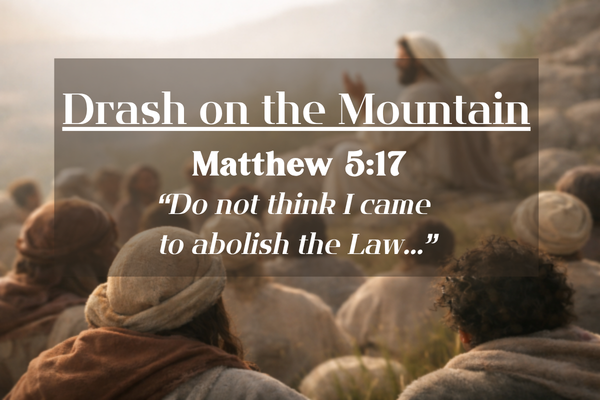
After Yeshua Messiah sets up the framework of what following God looks like, He says something that people interpret in many ways.
Not think that I have come to abolish the Torah or the Prophets. Not have I come to abolish, but to fulfill.
– Matthew 5:17
The first words of this famous statement are “Do not think.” To understand why, let’s look at what led to this:
The Kingdom Splits
After King Solomon, the kingdom of Yisrael split into two factions:
Under Jeroboam, Solomon’s servant- The tribes of Reuben, Simeon, Dan, Naphtali, Gad, Asher, Issachar, Zebulun, Ephraim & Manasseh become “Ephraim” in the North
Under King Rehoboam, Solomon’s son in Jerusalem- The Tribes of Judah, Benjamin and (some of) Levi remain and become “Judah” in the South.
Both kingdoms eventually fall under enemies, by guilt of idolatry:
- The Northern kingdom of Ephraim falls to Assyria first (around 722 BC )
- Then the Southern kingdom of Judah falls to Babylon for the same sin (605- 586 BC)
Ephraim falls
After the kingdom divided, King Jeroboam faced a problem:
And said Jeroboam in his heart, “Now may return the kingdom to the house of David. If goes up this people to offer sacrifices in the house of YHVH at Jerusalem, the the heart of this people will turn back to their Adon (Lord) unto Rehoboam, King of Judah. And they will kill me and go back to Rehoboam King of Judah.
– 1 Kings 12:26–27
So instead of trusting YHVH’s promise to establish him (1 Kings 11:38), he engineers a new religious system.
But he didn’t tell people to abandon YHVH entirely-
Therefore the King asked advice and made two golden calves and said to the people, “It is too much for you to go up to Jerusalem. Here are your elohim Yisrael, which brought you up from the land of Mitsrayim (Egypt).
– 1 Kings 12:28
- He sets up golden calves (echoing the sin in Exodus 32)
- Placed them in Bethel and Dan
- Created a new priesthood that is not from Levi
- Changed the feast timing (1 Kings 12:32–33)
So instead of obvious rebellion, it became a modified version of true worship.
And of nearly every subsequent king, it is said “He did not depart from the sins of Jeroboam, who caused Yisrael to sin”.
YHVH sends multiple prophets to Ephraim to tell them judgement is coming, but the kingdom does not repent.
Judah Falls
Unlike Ephraim, Judah cycles through obedience and disobedience: some kings are bad, some are good and reform the people.
But King Menashsheh is the main culprit for why Judah also fell:
- He reigned for 55 years- the longest reign of any Judean King; he misleads them for over half a century
- He rebuilds the high places and altars to Ba’al that his father tore down
- He worshiped the sun, moon, stars
- He built altars inside the House of YHVH
- He practiced sorcery, divination and necromancy
- He caused his son to pass through fire as a sacrifice
But not they paid attention and seduced them Manashsheh to do more evil than the nations whom had desolated YHVH before the sons of Yisrael.
– 2 Kings 21:9
Later Scripture says that Judah was removed because of Manashsheh-
Surely upon the word of YHVH [this] came upon Judah; to remove them from His sight because of the sins of Manashsheh, according to all that he had done.
– 2 Kings 24:3
Even though his grandson Josiah was one of the most righteous kings, destroying idols, restoring Torah and the Temple-
Surely not did turn YHVH from the burning of His great wrath with which was aroused His wrath against Judah because of all the provocations with which had vexed Him Manashsheh.
– Kings 23:26
So even later reform could not reverse what had been set in motion by disobedience.
The Warning Ignored
Back when Yisrael had wandered in the desert for 40 years, Moses gave them a warning:
When cuts off YHVH your Elohim the nations that you go there to dispossess from before you and you displace them and dwell in their land-
Shamar (keep watch, preserve) yourself that you are not ensnared to follow them after they are destroyed from before you, that you do not seek after their gods saying, “How did they the nations serve their gods? I will do thus also.”
Not you shall do in that way YHVH your Elohim; for every abomination to YHVH which He hates they have done to their gods. Even their sons and daughters they burn in the fire to their gods.
– Deuteronomy 12:29-31
- Do not be ensnared– from the root naqash which means knocked or struck down; to entrap
- The worship practices of the nations are abomination- toebah, meaning disgusting and aborent
This is exactly the sin that both Ephraim and Judah fall into.
Ephraim– the 10 lost tribes- refuses to repent all together and becomes scattered to the Nations, losing their identity.
But Judah remains as a community in Babylon for 70 years, and eventually returns to Jerusalem under Cyrus of Persia.
A People without a Kingdom
Before the people of Judah were exiled to Babylon, their identify was found in the Davidic kingdom, their land, and the Temple.
But afterwards the land of Judah becomes a Persian province- called “Yuhud”; they no longer rule as their own sovereign territory.
Their identity then shifts to focus on Torah, lineage and community. They begin to ‘close ranks’ and this is where in the book of Ezra the people are fearful to be led into repeating old patterns- the same ones that got them exiled in the first place. So they decide to send away their foreign wives and children of these unions.
This wasn’t a message of “Gentiles are bad forever”- that’s not in line with Torah or Scripture; the fear was these unions would tempt them to be led away from YHVH again, suggesting they were not “sojourners” who cleaved to Him, but pagans living in the land.
Then in the book of Nehemiah, they begin to read Torah again and interpret it for the people:
And they read from the book in the Torah of Elohim distinctly, and they gave insight and helped [them] to understand the reading.
– Nehemiah 8:8
Because they had lived outside the land, and many people likely spoke Aramaic, (not Hebrew), they now needed help to understand how to live out Torah in their daily lives. They needed to know things like
- What exactly counts as “work” on the Sabbath?
- How do purity laws apply outside the Temple context?
- What happens in mixed community environments?
They began to apply Torah principles to daily life. Those rulings were agreed upon by leaders and were eventually made an authority alongside Torah in their communities. What was meant to be interpretation only became the legalistic “oral traditions of man” that Yeshua later rebukes- because Torah says:
All the words that I have commanded you will guard it and do it. Not you shall add to it nor take away from it.
– Deuteronomy 12:32
This all reinforces and becomes the foundation of the Jewish world we see in the New Testament:
- Strong boundaries between Jews and non- Jews
- Community separation practices
- Emphasis on genealogical ‘purity’
- Torah-centered identity preservation
- Extra authoritative laws for daily life that have become burdensome
This is why He begins with “Do not think.”
Yeshua was from the tribe of Judah; He knew the Torah, He knew His people’s history, He knew they were afraid- and that fear had led them to blind compliance with burdensome laws and incorrect interpretation of Torah.
When He says “Do not think I have come to abolish the Law-“, it’s not just a mission statement- it’s a reassurance.
He’s saying
- Do not think I have come to lead you into idolatry or away from your Father again
- Do not think I am a false teacher or prophet here to deceive you
Because Torah also says:
If there arises among you a prophet, or a dreamer of dreams, and he gives you a sign or a wonder; and comes to pass the sign or the wonder of which he spoke to you, saying, “Let us go after other gods which not you have known and let us serve them”
Not you shall listen the words of that prophet or to that dreamer of dreams. For is testing you YHVH your Elohim, to know whether you love YHVH your Elohim with all your heart and with all your soul.
– Deuteronomy 13:1-3
Yeshua is effectively saying- I am not here to do this.
“Not I have come to abolish but to fulfill.”
Now, let’s look at what the text say in Greek:
Mē nomisēte hoti ēlthon katalusai ton nomon ē tous prophētas; ouk ēlthon katalysai alla plērōsai.
- Mē nomisēte: Do not think, consider, suppose
- hoti ēlthon: that, since- I came
- katalusai: to abolish; to tear down; destroy or dismantle; nullify
- ton nomon: the Law; Torah
- ē tous prophētas: or- to [them] the- Prophets;
- alla: but rather, on the other hand
- plērōsai: to fill, make full, bring to full expression and completion
So a more accurate reading of Matthew 5:17 is
“Do not think I came to dismantle the Torah and the Prophets; But rather I came to bring them to fullness.”
All of this shows that Matthew 5:17 is not moving away from what came before, but the moment where everything it pointed toward begins to take shape. In a history marked by repeated distortion, fear-driven safeguards, scattered identity and partial obedience, Yeshua is not introducing a new foundation.
He is declaring the true intent of the existing one. The Torah was never being discarded or replaced; it was being brought to its intended fullness in Him, so that what was once fragmented through Yisrael’s history would be restored, clarified, and lived out as it was always meant to be.
Leave a Reply