I’m sure most of us are familiar with the “Day of Pentecost” in Acts 2- the moment when the Apostles and the gathered believers received the Spirit. But when I first began studying the original appointed times of The Father, it was because while reading in the interlinear bible I noticed that the Greek word Pentēkostē means “the fiftieth day”. I admit I was confused because Acts 1 says Yeshua Messiah was teaching for 40 days before He ascended. So what did the significance of fifty have?
I looked into this and found a basic understanding- A Jewish festival that came after Passover, Shavuot which celebrates the giving of the Torah. Looking back, I think this was one of the first eye opening things that made me realize Torah wasn’t a bad thing. Because why would they celebrate a burden?
Recently Spirit prompted me to do a deep dive and I wanted to share with you all what I was led to.
Fair warning this is kind of a long one, but if you can bear with me it all ties together in the end.
The Feast of Weeks
Shavuot, which in Hebrew means “weeks”, is the completion of the fifty-day Count of the Omer commanded in Leviticus 23:
You shall count for yourselves from the day after the Sabbath-the day that you brought the sheaf of the wave offering- seven Sabbaths shall be completed. Until the day after the seventh Sabbath you shall number fifty days. Then you shall offer a new offering to YHVH.
– Leviticus 23:15-16
(If you didn’t catch this earlier post- we go over Passover, First fruits and the Omer here )
This appointed time was originally established as a harvest feast, celebrating the firstfruits of the wheat harvest and acknowledging YHVH as the provider of the land’s increase. But unlike the Feast of Unleavened Bread (Chag Ha’Matzot), the command for Shavuot is to include leaven in the offering.
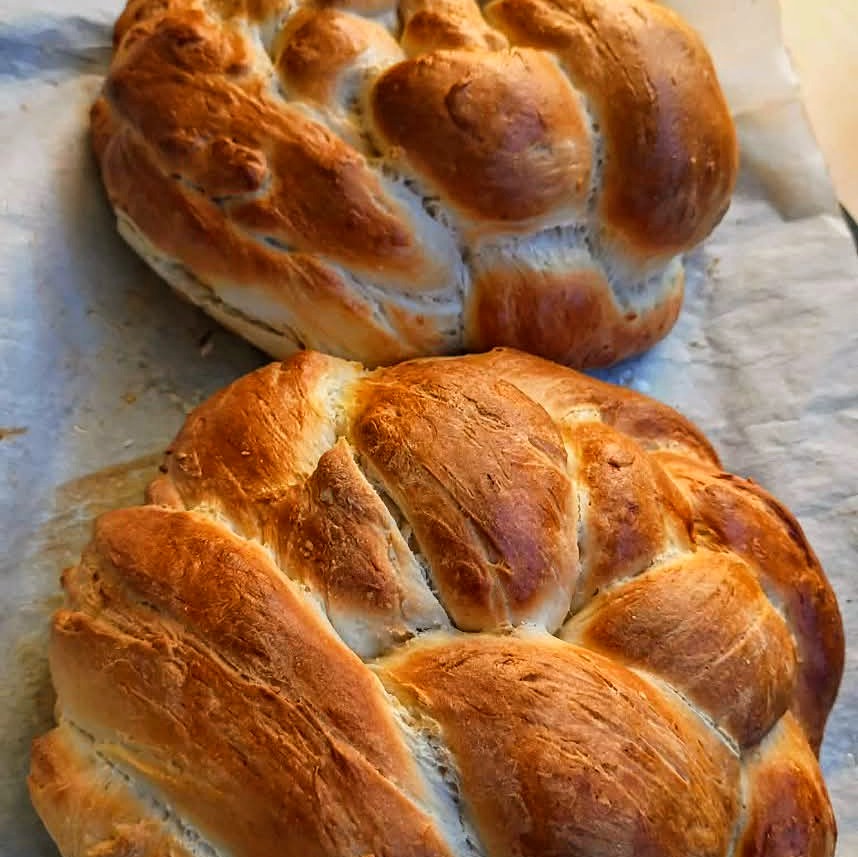
From your dwellings you shall bring two loaves for the wave offering. They shall [made] of two tenths [of an ephah] of fine flour. They shall be baked with leaven. They are firstfruits to YHVH.
– Leviticus 23:17
This is interesting because Shavuot is the only feast day commanded to offer leaven in the offering. And we know that leaven represents sin in later passages. So why would God ask for something representing sin in His holy offering?
To understand that, let’s look back to Exodus 19-
The Third Month
In the third month after the sons of Yisrael had gone out of the land of Egypt, on this the day they came to the wilderness of Sinay
– Exodus 19:1
In the third month after Passover, the people arrive at Mt Sinay
(Did you know it’s pronounced “see-nah’-ee” in Hebrew? I would have never guessed that.)
YHVH speaks to Mosheh:
You shall say to the house of Ya’aqov and tell the sons of Yisrael, “You have seen what I did to Egypt and I carried you on eagles’ wings and brought you into Myself.
Now if you hear and obey My voice and protect My covenant, then you shall be to Me a valued possession above all people, for all the earth is Mine. And you shall be to Me a kingdom of kohenim and a nation holy.” These are the words which you shall speak to the sons of Yisrael.
– Exodus 19:3-6
Notice that YHVH first states what He has done; He delivered them out of the slavery of Egypt.
Now He offers relationship if the people will shama– hear and obey Him.
That creates an important, lasting pattern for us-
Deliverance comes first; obedience follows
Mosheh gathers elders to tell them, and all the people agree, “All that YHVH has spoken we will do.”
Then YHVH tells Mosheh He will come in a thick cloud when He speaks so all the people will confirm the words forever (19:7-9).
And it came to pass on the third day in the morning that there was thunder and lightning, and a cloud thick on the mountain. And the sound of the shofar was very mighty.
So all the people who were in the camp trembled. And Mosheh brought the people out of the camp to meet Elohim. And they stood at the foot of the mountain. And the face of Har Sinay was completely covered in smoke because YHVH had descended upon it in fire.
And ascended the smoke like the smoke of a furnace, and the whole mountain quaked greatly. And when the sound of the shofar came and became very loud, Moses spoke, and God answered him by voice.
– Exodus 19:16-19
And after YHVH tells Mosheh to go and warn the people not to approach the mountain and to bring his brother Aharon back with him, He speaks the Aseret Ha’Davrim (the 10 words).
After the people hear His voice, the people are afraid and ask Mosheh to make intercession on their behalf. The next thing YHVH says is pretty crucial-
Thus you shall say to the sons of Yisrael: You have seen that I have spoken with you from Heaven. You shall not make with Me gods of silver, nor shall you make gods of gold for yourselves.
– Exodus 20:22-23
After giving further instructions concerning His altar and offerings, YHVH give Mosheh mishpatim (judgments or verdicts) for dealing with actual life commands (Exodus 21-23). He then calls Mosheh, Aharon, Nadab, Abihu and 70 elders to worship on the mountain; but only Mosheh may approach Him in the cloud. Mosheh goes and tells the people everything YHVH has commanded, and they again reply “All that YHVH has said we will do.” (for a second time)
In Exodus 24, he sends young men out to sacrifice oxen, and with the blood he consecrates the altar, the Sepher ha’Berith (The Book of the Covenant) and the people. He reads what he has been given to say and the Yisraelites accept for a third time,
“All that YHVH has said we will do and obey.”
So, they have accepted the ‘terms and conditions’ of relationship three times now:
- Exodus 19:8
- Exodus 24:3
- Exodus 24:7
Then, Mosheh, Aharon, Nadab, Abihu and the 70 elders go up on the mountain again:
They saw the Elohim of Yisrael, and under His feet was something like a pavement of sapphire, as clear as the very heavens. Yet He did not raise His hand against the chiefs of Ben-Yisrael. So they beheld Elohim, and ate and drank.
– Exodus 24:10-11
In Hebrew culture, sharing a meal after cutting a covenant symbolized peace and relational unity between both parties which symbolically seals the oath. This was not merely eating, but a covenant meal before YHVH Himself. The Chiefs among the Yisraelites are invited into communion in His presence, showing that covenant was always meant to lead not only to obedience, but to fellowship with our Father.
And said YHVH to Mosheh, “Come to Me on the Mountain and be there. And I will give you tablets of stone, and the torah and mitzvot which I have written, and you shall teach them.
– Exodus 24:12
Then as we know Mosheh spends 40 days on Mt Sinay, receiving all YHVH’s instructions.
40 Days in Scripture
40 is another pattern in scripture that symbolizes a new stage after testing, purifying, and preparation:
- Genesis 7 and the Flood: judgment, cleansing, reset/new beginning
- later the Yisraelites wander for 40 years in the wilderness: judgement, testing, cleansing, reset (because the generation of slavery mindset dies out)
- Nineveh gets a 40 day warning from Yonah to repent
- Yeshua is in the wilderness for 40 days of testing and preparation for His ministry
- Yeshua teaches for 40 days in Acts 1: preparation for His departure and transition into the next phase of Covenant- receiving the Spirit
The Golden Calf & Judgment
And when the people saw that Mosheh tarried coming down from the mountain, the people assembled upon Aharon and said to him, “Arise! Make us elohim that shall go before us. For Mosheh, the man who brought us out of the land of Egypt, we do not know what has become of him.” And said Aharon to them, “Tear away the golden rings in the ears of your wives and your sons and daughters and bring them to me.”
So the people tore off the golden rings in their ears and brought them to Aharon. And he received it from their hands and formed it with a chisel, and made a calf of molten metal.
And they said, “This is your Elohim Yisrael that brought you out of the land of Egypt.” And Aharon saw it and he built an altar before it. And Aharon proclaimed and said “Tomorrow is a feast to YHVH!”
– Exodus 32:1-5
For whatever reason, the people who just agreed to obey and do what YHVH said, immediately disobey the first command they were given- “You shall have no gods over Me“.
YHVH, upon seeing their idolatry, tells Mosheh to go down and deal with them. He says His wrath burns against them and briefly contemplates wiping them out completely and starting over with Mosheh, calling them am qasheh oreph– “Stiff necked/ hard headed people”. But Mosheh intercedes on their behalf.
He goes back down with the two tablets of the eduth (Testimony), written on both sides, engraved by YHVH. Yehoshua hears singing as they get closer to the camp. Mosheh becomes so angry when he sees the celebration, that he throws the tablets down, breaking them. Then he takes the calf and burns it, grinds it into powder, throws it in the water and makes the Yisraelites drink it (32:15-20).
He rebukes Aharon, who he left in charge. But Aharon says he could do nothing as the people were set on evil. Mosheh then goes before the camp and says to the people, “Whoever is for YHVH, come to me!” and all the sons of the Tribe of Levi gather to him (32:26).
And he said to them, “Thus says YHVH Elohim of Yisrael: Let set every man his sword on his thigh. Go in and out from gate to gate throughout the camp, and slay every man, his brother and his companion and his neighbor.”
So the sons of Levi did according to the word of Mosheh, and falling from the people that day were about 3,000 men.
– Exodus 32:27-28
So immediately after the covenant revelation at Sinai, Yisrael fell into rebellion with the golden calf, revealing that even after witnessing the fire, thunder and voice of God, the people were still imperfect and prone to sin.
The leavened loaves included in the Shavuot offering therefore can point us to a greater symbology-
The reality of covenant relationship with a flawed people: people whom God still chose to call His own- despite their weakness and continual need for correction.
Jeremiah 31
That tension continues throughout Yisrael’s history and becomes central to the promise spoken later through the Prophet Jeremiah, when YHVH declares that the problem was never with His Torah, but with the hearts of the people who struggled to faithfully walk in it.
Jeremiah 31 is written to the Exiles of Judah in Babylon- the entire book is about how rejection was inevitable after a lack of repentance, but restoration is still promised. It opens with a call back to the events of Exodus 32:
Thus says YHVH, “The people who survived the sword found grace in the wilderness, where I gave Yisrael rest.”
Jeremiah 31:1
YHVH says He is going to bring the scattered northern tribes back into His fold, where He promises they will no longer stumble-
With weeping and supplications they will come. I will bring them, leading them to walk by streams of water on a straight path where they will not stumble. For I am Yisrael’s father, and Ephraim is My firstborn.”
Jeremiah 31:9
Calling Ephraim “firstborn” is a way of saying:
- they are still honored despite exile and judgment
- they retain covenant identity in the restoration
- they will be included in the coming renewal alongside Judah
In those days they will no longer say:
‘The fathers have eaten sour grapes, and the children’s teeth are blunted.’
Rather each will die for his own iniquity: if anyone eats the sour grapes, his own teeth will be blunted.”
– Jeremiah 31:29-30
This is a proverb meaning “We are suffering only because of our ancestors’ sins.”
YHVH is saying this mindset will be corrected-
- national exile is ending
- blame-shifting is being removed
- each person will be accountable for their own rebellion
“Behold, days are coming” Says YHVH- “when I will cut a berith chadash (covenant renewed) with the house of Yisrael and with the house of Judah. Not according to the covenant I made with their fathers in the day I took them by the hand to bring them out of the land of Mitsrayim, which the covenant that they broke though I was a husband to them.” Says YHVH
“But this is the covenant I will make with the house of Yisrael after those days” says YHVH
“I will set My Torah within their minds and write it on their hearts. I will be their Elohim and they will be My people.
No longer will each teach his neighbor or each his brother, saying: ‘Know YHVH’ for they will all know Me, from the least of them to the greatest.” Says YHVH.
“For I will forgive their iniquity, their sin I will remember no more.”
– Jeremiah 31:31-34
This well known passage is quoted in the New Testament about the berith chadash- “Renewed Covenant” in:
- Romans 11:26-27
- Hebrew 10:16-17
Together, these passages reveal that the promised Renewed Covenant was never about abolishing Torah, but about restoring the relationship between YHVH and His people through inward transformation.
The problem presented throughout the prophets was never that YHVH’s Torah was flawed, but that the hearts of the people continually turned away from it. Yisrael repeatedly broke covenant, not because the instructions were no-good, but because human hearts were stubborn, rebellious and spiritually hardened. The promise of the Renewed Covenant, therefore, was not the removal of Torah, but the renewal of the people themselves.
Ezekiel 36
Jeremiah 31 speaks of Torah being written upon the heart, but Ezekiel 36 expands upon how this restoration would occur.
The entire chapter is a prophecy spoken to the mountains and land of Yisrael after judgment and desolation. The message shifts suddenly from condemnation in the earlier chapters toward restoration. After promising that the enemies who boast of His people’s failure and exile will soon meet their own destruction, in verses 17-23, YHVH plainly states that He has concern for His Name and because of that He will raise them back up:
“The nations will know that I am YHVH” Says Adonay YHVH “when I am sanctified in you before their eyes.”
And I will take you from among the goyim and gather you out from all the earth and bring you into you own land. And I will scatter over you water pure, and you shall be cleansed from all your uncleanliness and I will cleanse you from all your idols.
And I will give you a renewed heart and set within you a renewed ruach (Spirit). And I will remove the heart of stone out of your flesh and give you a heart of flesh.
And I will set My Ruach within you and I will make you to walk in My statutes and you will preserve and do My judgments. Then you will live in the land that I gave to your fathers. You will be My people and I will be your Elohim.
– Ezekiel 36:23-28
YHVH promises to restore the Sinay Covenant, but this time with hearts softened, cleansed, and made willing to walk in faithfulness. Instead of the instructions of YHVH remaining merely external words written on stone, the prophets spoke of a day when His Torah would be written upon the heart itself, producing obedience flowing from relationship rather than mere outward obligation.
This expectation forms the backdrop for the New Testament understanding of the Spirit’s outpouring, where the Apostles saw these prophetic promises beginning to unfold among the followers of Yeshua Messiah.
Acts 1
In Acts 1, Luke says Yeshua appeared and spoke to the apostles for 40 days (1:3). As we said before, this is a parallel between Mosheh and Messiah:
- Mosheh ascends and dwells in the cloud for 40 days and returns with the Testimonies of the Covenant
- Yeshua ascends after 40 days of instruction, then the Spirit comes, beginning the Renewed Covenant
But whereas Yisrael became impatient and disobeyed with the golden calf, the Apostles remain unified in prayer (1:14). Peter reasons that Psalm 69:25 and 109:8, David’s complaints about his own enemies, actually foreshadowed Judas betraying Messiah, and they cast lots for the replacing Apostle.
Acts 2
When the day of Shavuot had come, they were all together in one place.
Acts 2:1
For the sake of context- because we know
- Yeshua Messiah was resurrected on Firstfruits; the Waving of the Omer
- The count of the Omer is 50 days- Pentekoste is the fiftieth day
- He taught for 40 days
This would be 10 days after Messiah ascends.
And there appeared to them divided tongues as of fire and set upon each one of them. And they all were filled with the Ruach ha’Kodesh, and began to speak in other tongues as the Ruach was placed to declare to them.
– Acts 2:3-4
In Greek, tongues is Glossai; figuratively languages or speech
But the interesting word is Diamerizō which means distributed; to apportion among many.
We can infer that Luke likely uses this wording for a few reasons- to show parallels between Genesis 11 and Numbers 11:
Genesis 11:7-9 “let is go and balal their tongues…”
- balal- confuse, scatter, or mix-up
- Because YHVH divided their languages the world became divided
- Now divided tongues unify them in the Ruach
Numbers 11:17, 25 “I will atsal the Spirit upon you and set it on them…”
- atsal– to allocate, share from or disperse
- Spirit shared among 70 men only
- But now the Spirit is given to many
But also to show us this is the Sinay Covenant made full:
On Mount Sinay, the fire of YHVH converged on one place- the mountain itself. It became set apart, surrounded by boundaries, and only Mosheh could ascend into the cloud and enter the Presence as mediator. From that point forward, access to YHVH’s presence was mediated through sacred spaces: the Tabernacle and later the Temples, where His glory dwelt above the cherubim, approached only through priesthood, sacrifice and His appointed order.
The pattern throughout the Tanakh is consistent: the Presence of YHVH is real among His people, but localized, guarded, and mediated:
- At Sinay the fire rested on a mountain.
- In the wilderness it rested on the Tabernacle
- In Jerusalem it dwelled in the Temple
But in Acts 2, at Shavuot:
The fire is no longer concentrated in one place YHVH deems- it is now distributed among the assembly. “Tongues as of fire” rest upon each one in the upper room. What was once centralized now becomes shared; what was once external and national, now becomes internal and personal.
The holiness of YHVH is not diminished, but extended. The prophetic promises are fulfilled: His Spirit is poured out, His Torah is written on hearts, and His presence dwells within His people rather than only above them.
In Acts 2 after the Ruach has enabled each to hear “the magnificence of God” in their own language, some are still doubting and mocking. Peter stands up and tells them what is happening is what was prophesized by Joel:
‘And it shall come to pass after thus that I will pour out My Ruach on all flesh. Your sons and your daughters shall prophesy, your young men shall see visions, and your old men shall dream dreams. And also on My slaves, male and female, I will pour out My Ruach in those days.
And I will give wonders in the heavens above and on the earth- blood, and fire and columns of smoke. The sun shall be turned to darkness and the moon to blood before the coming of the great and glorious day of YHVH. And it shall be that everyone who calls on the name of YHVH shall be saved.”
Joel 2:28- 32
When the crowd hears Peter say Yeshua has been made both Adonay (master) and Messiah, they are pierced to the heart and ask what they need to do?
Peter declared to them, “Metanoesate and be immersed every one of you in the name of Yeshua Messiah into the forgivness of your sins and you will recieve the gift of the Ruach ha’Kodesh.”
Acts 2:38
The Greek word metanoesate comes from meta and nous
- meta- after, beyond; altar, change
- nous- mind, understanding, way of thinking
In Acts 2 it’s being used as an aorist imperative
- Aorist tense- the simplest form of an occurrence, which doesn’t indicate ongoing, repeated or completed action
- imperative- a command, absolute necessity or an obligatory duty
So the statement is “Make a decisive turn- All of you!” which is then immediately paired with immersion, so the focus is on an active and urgent turning response, not just intellectual regret.
Then in Acts 2:41, “about 3000 souls were added”- the same amount as the Tribe of Levi had slain in judgment when the people broke the covenant the first time.
So we’ve had several parallels showing continuity from the Old Testament to the New Testament:
| At Sinay | In the Upper Room |
| Ritualized purification commanded | Spirit given without purification |
| Torah given externally | Desire to obey from within |
| People fall to idolatry | Many convicted to repent |
| 3000 slain in Judgement | 3000 saved through Grace |
As stated earlier, Shavuot is unusual because it’s the only feast where the offering includes leavened bread.
That’s striking when we connect it with Acts 2 as imperfect humans receiving His Spirit. Today we can link the two loaves to the representation of
- Judah + Ephraim
- Jews + Nations
- The beginning Covenant and the Covenant Renewed
- A unified people brought before YHVH despite imperfection (leaven)
How We Keep Shavuot Today
While many of the original Temple-centered elements of Shavuot cannot be fully practiced today, the appointed time itself still remains holy and set apart.
In Deuteronomy 16, the emphasis of Shavuot is not only upon offerings, but rejoicing together before YHVH as an entire community. The feast was to include sons and daughters, servants, Levites, foreigners, the fatherless, and widows- reminding Yisrael that covenant joy was never meant to be isolated or exclusive. Shavuot was a time when everyone was invited to gather in gratitude before YHVH and remember both His provision and His redemption.
We preserve and honor Shavuot today by remembering the instructions of Leviticus 23, setting the day apart from ordinary labor as a High Sabbath, gathering in fellowship, rejoicing with family and community, studying the Scriptures surrounding Sinai and Acts 2, and giving thanks for both physical and spiritual provision.
The themes woven throughout Shavuot invite us to renew our devotion each year, and reflect on the faithfulness of YHVH throughout every generation.
Shavuot is not merely a memorial of harvest, nor only a remembrance of Sinay or even Torah; nor only the day of Pentecost- it is the convergence of all of these. It calls us to rejoice in YHVH as Provider, to remember His covenant revelation at Sinay, and to walk in the reality of His Spirit poured out through Yeshua Messiah. To keep it holy is not to burden the day with added requirements, but to intentionally set it apart in gratitude, covenant remembrance, fellowship, and renewed devotion before YHVH.
So let’s take this time to marvel at what an Awesome God we serve, thanking Him in His eternal wisdom and for His plans to bring us into His covenant of Peace.
Leave a Reply